Quest for Immortality – The World of Ancient Egypt Exhibition


 •
• What happens after death?
The ancient Egyptians asked, and answered, this universal question in their own rituals, art and illustrations designed to explain the otherwise inexplicable. Thanks to the preserved artworks and tombs, modern people are able to understand a little better the mystical history of the Egyptians.
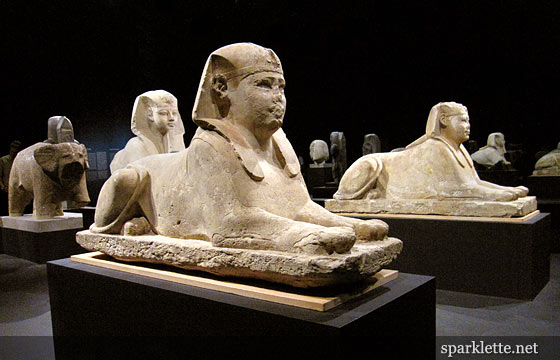
At the Quest for Immortality exhibition held in National Museum of Singapore, we can feed our fascination even further. It is not everyday that an exhibition on ancient Egypt comes to town, so this is a rare opportunity where we get to see actual relics, artifacts and mummies, some as old as 6000 years, up close.
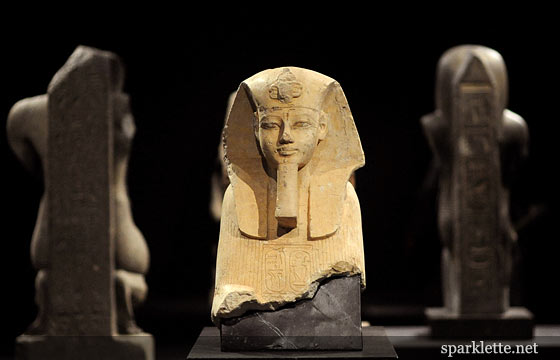
In all, 230 artifacts, including 3 mummified bodies, are being exhibited. One of the most valuable exhibits is the Sphinx of Amenhotep III statue (picture above), valued at about $1.4m.
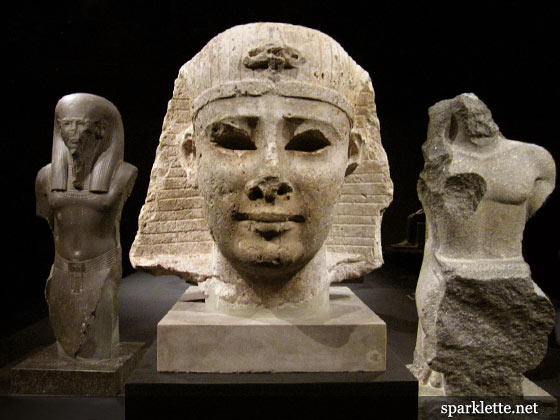
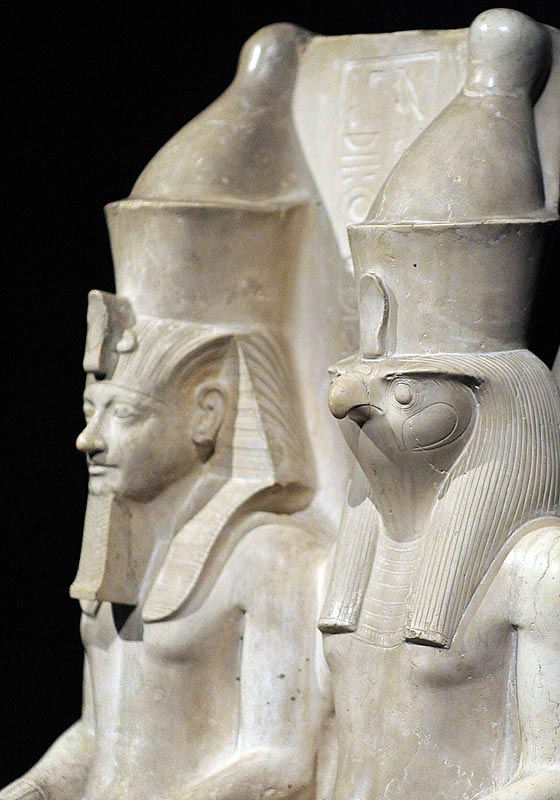
This limestone statue from 1323-1295BC depicts the god Horus seated side by side with King Horemhab, who was believed to be the earthly incarnation of the god.
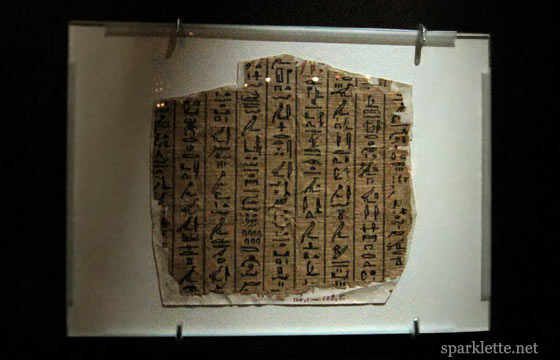
This papyrus fragment with hieroglyphic writing was placed in tombs to guide the dead into the afterlife.
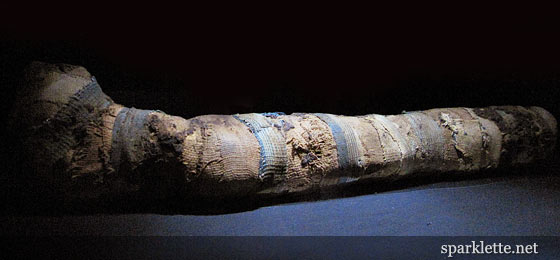
Aside from humans, the Egyptians mummified animals as well, including the cat. Can you spot the tip of its nose?
Of all the exhibits, the cat mummy makes me feel the saddest, especially after learning that kittens were mummified as well.
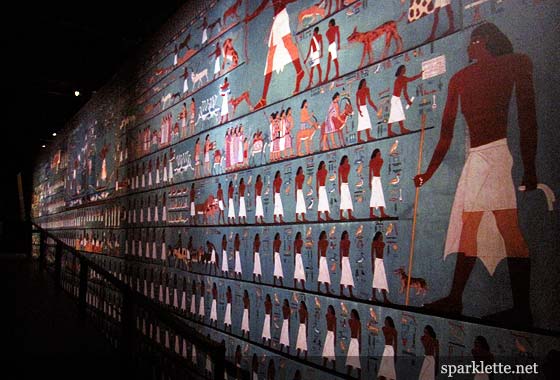
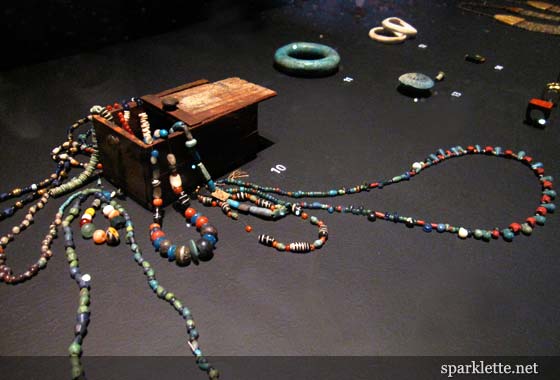
Exhibits also include varied pieces of ancient Egyptian jewellery, including ear studs as big as 50-cent coins! Surely that would result in enlarged earlobes, not unlike the modern body modification.
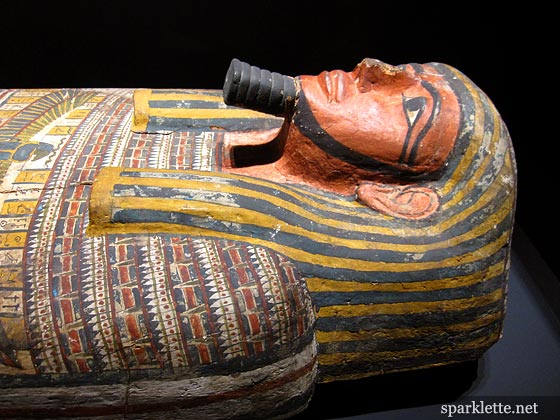
For the dead to be recognised in the afterlife, their bodies were fitted with cartonnage mummy masks. These masks show the idealised features of the deceased, and are often gilded in gold to achieve a godlike form.
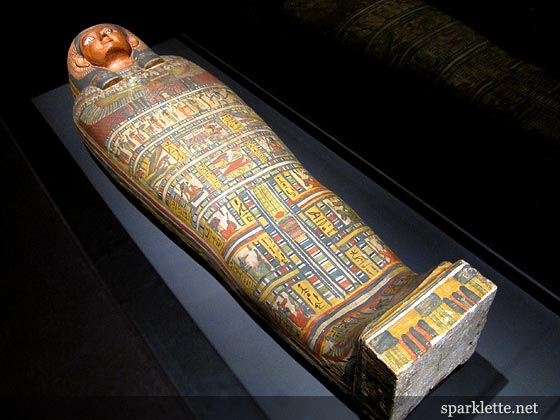
The mummy coffins are pieces of art in their own right!
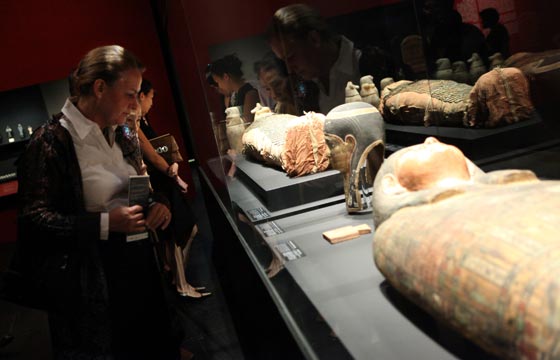
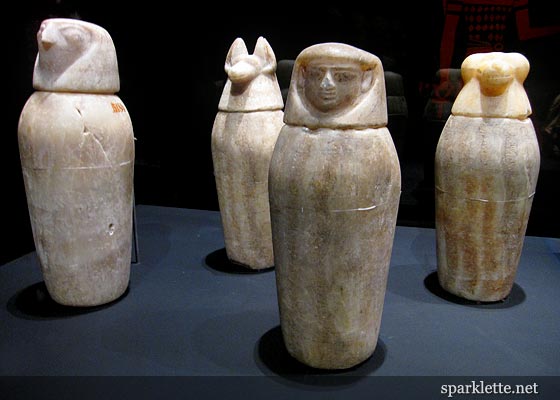
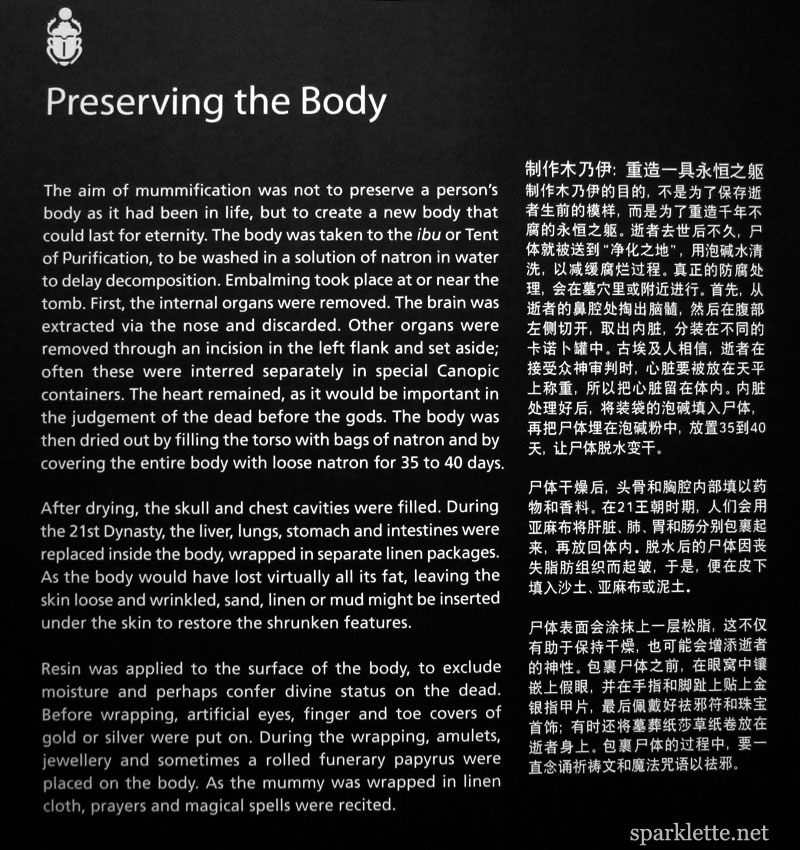
These four canopic jars bear the shapes of the god Horus’ four sons – falcon, human, jackal and baboon. Can you guess what these containers are for? The answer is in the following write-up.
Click to enlarge
The exhibition features many information boards that provide useful explanations and elaborations on the Egyptian rituals and legends. This one elaborates on the details behind the process of mummification.
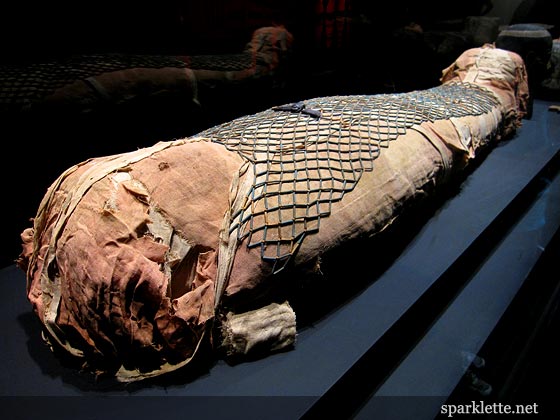
This is the mummy of Nekhet-iset-aru wrapped in pink linen cloth and strips of bandages. A blue beaded net design was placed on it. It represents the sky and places her under the protection of the sky goddess Nut.
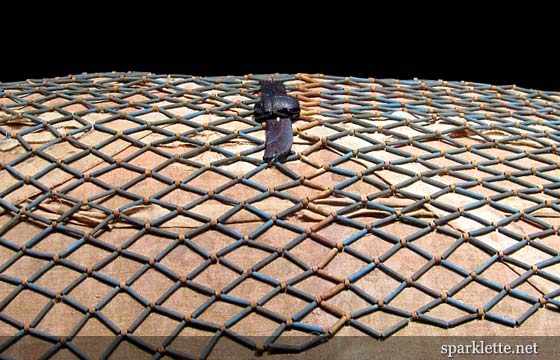
The winged scarab, placed on top of the beaded nut, served to protect the heart.
Source: EPA/BGNES
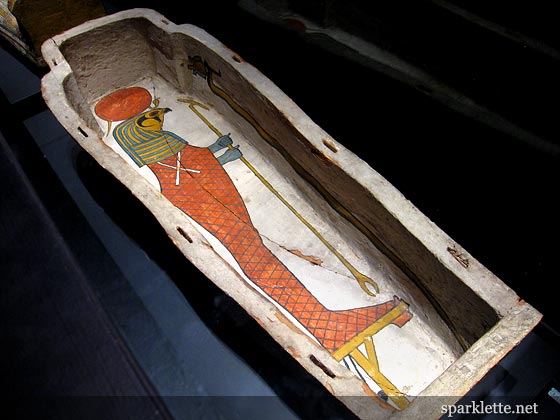
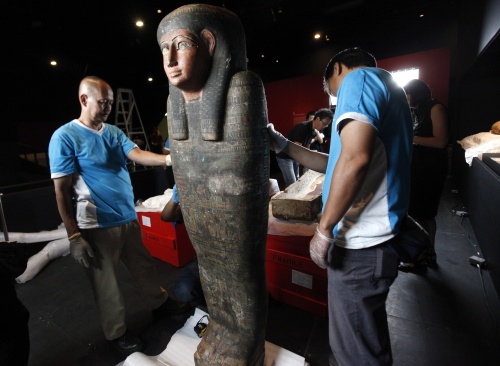
This is the cartonnage coffin of the mummy of Nekhet-iset-aru, seen here being prepared for the exhibition by art handlers. Special prayers had to be carried out before the mummies were placed.
The exhibition ends April 4, 2010. Be sure to catch it here while you still can!
Ends April 4, 2010
Time: 10am – 6pm
Venue: National Museum of Singapore
Admission fee: S$15 for adults, free for students and Singapore citizens and Permanent Residents above the age of 60
Website

Mar 12, 2010
https://sparklette.net/wp-content/themes/v3195
My journey to ancient Egypt + Mummy Pics at http://sparklette.net/travel/singapore/a…
Mar 12, 2010
https://sparklette.net/wp-content/themes/v31
@sparklette Nice pic!… and do you know about dangerous Bezness in Egypt with tourist women? http://www.tunisiepro.net/tunisia/tunisi…
Mar 16, 2010
137
Good pictures. Now I know what to expect when I go there this weekend :P
The mummy looks creepy. Especially since you zoomed in to the head portion!
Mar 17, 2010
3472
There are true stories of explorers and archaeologists who died mysteriously one after another after opening Egyptian tombs. So it does feel a little eerie when we are looking at a real mummy up close! The feeling is starkly different from going to the BodyWorlds exhibition. For the latter, you know that the bodies came from people that had willingly pledged their bodies to be exhibited. As for the mummies, it’s a different thing!
Mar 19, 2010
137
ooo I vaguely remember some stories. They died from fever or malaria etc. Scary ><
Mar 19, 2010
3472
If you read the Adventures of Tintin comic series, one of the stories revolves around this.
Mar 18, 2010
182
Wonderful photos. I particular like the angle which the statue of god Horus seated side by side with King Horemhab was being taken. Thank you for the article.
Mar 19, 2010
3472
You are most welcome! That photo with the two seated side by side was in fact provided by the museum. I tried to take a photo from the same angle, but my pocket camera could not do it justice. That’s one of my favourite pictures, too!
Apr 1, 2010
3
Hi!
Just went to the exhibition today, and it was great!
Btw, there’s a 50% discount for visitors paying using Mastercard, so do grab the chance if interested.
Apr 2, 2010
3472
Thanks for the tip! I’m sure people who are headed for the exhibition would appreciate it.
Apr 4, 2010
4
Great exhibition!
Was there on Sat and inside for 2hours+.
My conclusion : Amazing !
And also nice pictures you have! =)
Apr 4, 2010
3472
Thanks! This is probably the one and only time we can see Egyptian mummies in Singapore so I took as many pictures as I could :)
Apr 4, 2010
7
Managed to go down today to catch this exhibition! and FREE admission!! Lucky I didn’t miss this amazing exhibit :)
Sep 13, 2012
1
I wanna be Mummified!!!