

It all began like this…
“Wanna drink sh*t?” my friend D asked excitedly.
“What??” I demanded, unsure whether it’s a genuine question or insult.
“You wanna drink sh*t or not?” he persisted, like that’s the most natural thing in the world. “Come, come, I show you.”
Intrigued, and a little disgusted, I followed him to where another friend K sat. K had just returned from the depths of the Indonesian jungle. He brought back with him a small bottle of brown substance.
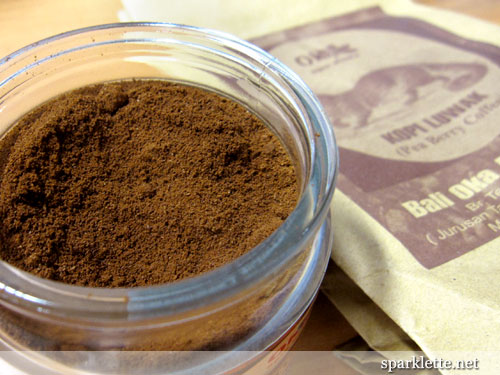
And that is how the 3 of us ended up drinking animal poop coffee (poop of this animal called the civet) together. Civet coffee is also known as “weasel” coffee, although the two are in fact different animals. This particular endangered breed, the Asian palm civet, feed on red coffee cherries. And only the finest and best-tasting cherries would do for this fussy tree-dwelling mammal!
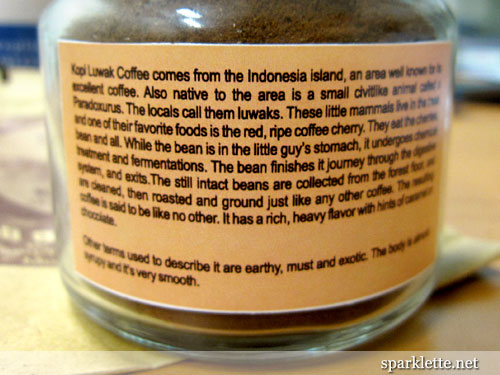
In the animal’s stomach, enzymes break down the proteins that give coffee its bitterness. The beans within the coffee fruit are then, er, defecated, while still remaining intact.
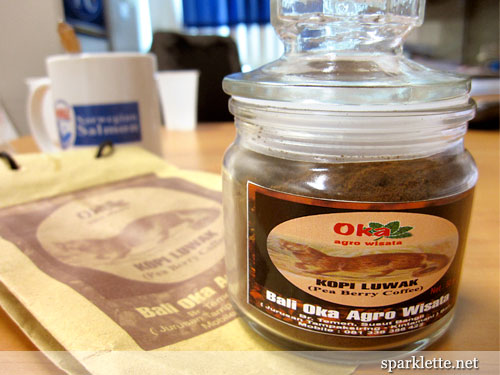
These are cleaned thoroughly (of course!), roasted and ground into powder that is fit and safe for consumption! Oh, the journey that those beans must have gone through, only to end up in another stomach!
Civet coffee is produced only in a few parts of southeast area, with less than 1000 pounds of it available worldwide every year. Due to such exclusivity, a pound of it costs between US$100 and US$600, easily making it the most expensive coffee in the world!
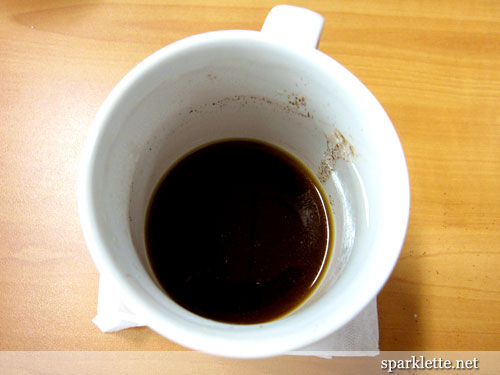
The brewed coffee has a very dark shade of brown with some red undertones. Just a quarter-filled cup of it is sufficient to produce an extremely rich and sweet coffee aroma.
Next comes the taste test. I have expected the coffee to be really strong and bitter, but it turns out to be surprisingly smooth and light and not bitter at all.
Some people claim that it has a chocolaty flavour, but what I detect is more caramel-like and nutty. It doesn’t have that sharp acidic taste. Nor does it leave you with any distinct aftertaste. Although it’s not bitter (thanks to the civet), I do like it with a small teaspoonful of sugar.
And that’s my first experience of drinking kopi luwak.
If I were to ask you: what is the most exotic thing you have ever had? What would your answer be?
Someone posed me this question recently. And I realised that I had never actually tasted anything truly exotic. Each time I had the chance to sample something novel like wild boar in Macau and ostrich meat in Siem Reap, or fear-factor worthy stuff like the fried bugs in Bangkok, I chickened out. I don’t know if the dried puffer fish I had at tetsu counts. It actually tasted good!
Now I’m proud to say that I have had Kopi Luwak, the most exotic coffee in the world!

Jun 14, 2009
3
Hi, I’m from Indonesia and not very long ago I was in Bali.
Kopi luwak is indeed a very exotic coffee, and it *must be* very expensive. Unfortunately, in Bali some of them promote packets called luwak coffee but it’s only a mixture of maybe 0.2% of luwak coffee with 99.8% of normal coffee. It really happens. The original luwak coffee costs about 160k Rupiahs (about 20 S$) for just 8 grams of unfiltered ground coffee! Seeing the photos on this post, a big jar like that should have cost hundreds of dollars. Is it really so? If not, it maybe a counterfeit product.
Jun 15, 2009
3472
Wow. When these things sell for so high a price, there would always be people that start peddling the fake products. Even if a jar of coffee costs hundreds of dollars, I would imagine it’s impossible to tell whether it is the real stuff or the fake stuff!
Jun 19, 2009
1
thats right tellem
Jun 14, 2009
17
So… does the taste justify the price? =D
I sometimes see palm civet poo on the boardwalk at Chek Jawa. Which is always an excellent opportunity to talk about kopi luwak.
Jun 15, 2009
3472
Good question! The taste is not as good as the aroma. I can only say that it’s not the world’s best-tasting coffee. And that’s a good thing! Otherwise I would be running to my friend K for his coffee everyday.
Jun 14, 2009
3
nice nice nice! I always thought of having exotic stuff. I own a food blog and I never had any exotic stuff b4…. bugs… no way… coffee, even from the dung….. yes please…. =) nice nice coffeeeee
Jun 15, 2009
13
is this the same “Kopi Lew-ak” fetured in The Bucket List?
i remembered because it was in the scene where Morgan Freeman made Jack Nicholson read the history of Kopi Luwak, and they both laughed hysterically after the reading. :)
Jun 15, 2009
3472
I think it is! Hahahaha
Feb 15, 2011
3472
I just finished watching The Bucket List for the first time on DVD and remembered your comment :) Surprised that Kopi Luwak features quite prominently in the movie. I like the movie. My eyes were wet by the end.
Jun 19, 2009
3
I bought some kopi luwak in Jogja and it was cheap.
Either you got cheated or I did.
I’m guessing it was me.
Damn Indons.
Jun 20, 2009
1
kopi luwak is available in most part of coffee plantation in indonesia. And available in robusta, arabica and liberica.
And may be classed by origin, depending the location.
Most of kopi luwak on the markets doesnt describe the origin and variety. Its important to drinker to know where their coffee come from. Since different coffee plantation produce diferent coffee taste character. At least arabica or robusta must be specified.
Now the luwak are caged! Just like chicken, fed them coffee, and produce kopi luak!
Some are dometicate in in few hectar and between coffee plantation.
The cage luwak produce coffee in different way, since human pick the cherries, luwak exploited to produce kopi
In the wild luwak select beam itselft, and consume not only coffee in their diets.
But whatever, the high quality kopi luwak may be value by their taste and aroma. Not only from genuity oh them only. The production way, process and roating take part to the coffee quality.
Aug 3, 2009
1
where can i drink kopi luwak in singapore?
Aug 3, 2009
3472
I think Trung Nguyen (outlets at Marina Square and Liang Court) have it, but I can’t be 100% sure. Even so, there is no guarantee if the stuff is authentic.
Sep 18, 2009
1
Here are some rules to buy Kopi Luwak safely.
Do not trust in:
Cheap Prices. Considering the scarcity of the authentic product, pure Kopi Luwak cannot be sold at low prices. In fact, Kopi Luwak has an annual world production of around 500 to 700 kg, that is why it is such an expensive product.
Blended Kopi Luwak. Do not buy any product that claim to be a blended coffee. You never know how much percent of Kopi Luwak was added in the blend, sometimes only 1%, in other words, NOTHING. You will see that the product is quiet cheap in relation with a pure Kopi Luwak.
Wholesale. Considering the scarcity of the authentic product, it is almost impossible to sell this product for massive consumption unless the product contains a lower quantity of the genuine beans of Kopi Luwak. Al’s Original Coffees is offering you to try the authentic Kopi Luwak.
Certificate of Authenticity. This certificate can be true but it only certifies the sample of the coffee sent to the laboratory and not the product you will receive. Imagine sending every coffee bags of 30 grams to the laboratory, then packed and sealed there after certification. It is a difficult and expensive process, isn’t it? That is why, it is not serious the argument, which states that the coffee has been checked and approved by a famous doctor.
Guaranteed by a famous coffee gourmet. In the world, only few people have tried the genuine Kopi Luwak so it is difficult to compare taste, aroma, body, and acidity. Nobody is able to guaranty that the coffee is the genuine Kopi Luwak just by trying it.
Taken from http://www.realkopiluwak.com the site has plenty info about kopi luwak
Nov 14, 2009
2
Most of the commercial sold Kopi Luwak are home fabricated with home reared luwak feeding with coffee beans.
Nov 14, 2009
2
home reared luwak should be corrected as `home reared civet cat`.
Aug 16, 2010
1
agree, luwak coffee is really good.
i was recently given a 250 gr of kopi luak (wonder how much they cost), and it’s really really good. for you all coffee lovers out there, try kopi luwak out! the brand that i’m having now is Wak Noer’s Loewak. any suggestion for other brands?
Aug 19, 2010
1
Well to me the best coffee is a good Colombian coffee,not only for the texture, colour and aroma. you will see it the way that shines, Colombian coffee is not only a tradition is also a Culture a way of living, it is like a beautiful woman most have romance love passion. There is no need to pay 300 or 600 dollars for a defecated coffee. and someone to tell you “it is great”.
When you get Colombian coffee you will taste nature at its best… one more thing yes I’m Colombian.
Apr 11, 2011
1
I think you should try Kopi Luwak Tapis. You can buy from the web as well at http://www.tapisluwak.com
Its very easy to get this coffee as they have so many representatives around the world. I bought it last week, and taste GREAT and got a hint of dark chocolate…
Sep 2, 2011
2
Wow, again my internet search arrives to yr site.
My gf is in bali right now, so thought of asking her to buy back some kopi luwak.
Now i’m wondering if she can really get the real thing! :)
Alwyn
Aug 22, 2012
1
If you visit Jakarta, Indonesia, taste the original kopi luwak at KOPI LUWAK cafe (same brand name) outlet especially in Jakarta’s big mall such as Plaza Indonesia, Mall of Indonesia, etc. There are around 20 outlets and you can search on Youtube about CNN coverage. The outlet also sells the coffee in various degrees of blend, 100%, 50%, or 30% of kopi luwak for beginners. The beans are sold at the highest price $90 per pack. By the way, the guys at KOPI LUWAK outlet didn’t pay any buck. Just trying to help you find the original kopi luwak :).